
A few days back, Atul Ganatra, president of the Cotton Association of India, presented a grim scenario of the crop's prospects in the 2024-25 season that starts in October. Addressing the association's annual general meeting, Ganatra said the area under the crop could go down by at least 10 per cent in the coming season due to falling yields and realisation, leading to farmers losing interest. The fear of a decline in acreage comes against the backdrop of India's cotton production probably falling to its lowest in a decade, according to estimates.

Bankers said the outlook of M&As in India in 2024, especially in the second half after the Lok Sabha election, seems relatively better.

Oral paracetamol and another cough medicine manufactured by companies based in Mumbai and Punjab were found to be "sub-standard or found to be containing toxins", reports Sohini Das.

rediffGURU Ramalingam Kalirajan answers your personal finance queries.

'AI is not a new thing for us. We started our AI journey in 2015.'

After pulling out $17 billion in calendar year 2022, foreign portfolio investors (FPIs) have pumped $7.3 billion back into equity markets so far this year. The turnaround in foreign flows has helped domestic markets exceed the all-time highs chalked up in December 2022 and bounced back more than 10 per cent from this year's lows. However, a big nugget of FPI inflows seen this year could be off the back of two factors: exchange-traded funds (ETFs) and block deals.

72 per cent of the revenue of Indian firms (India Inc) is derived from the domestic / home market - the sixth highest in percentage terms in the emerging market (EM) and the Asian region, said a recent report by Morgan Stanley. The balance, according to the report titled 'Global Exposure Guide 2021' co-authored by analysts led by Jonathan F Garner, their chief Asia and emerging market strategist, is split between the developed markets (DMs) and other EMs. The report is based on an analysis of 3,300 companies globally that have revenue exposure in 17 different regions.

Large investors track high-frequency data that is immediately available today. That data has been bullish, points out Debashis Basu.

Fund managers of large-cap and equity-linked saving schemes (ELSS) have demonstrated a marked improvement in their performance over the past year, according to the latest SPIVA (S&P Indices Versus Active) report released by S&P Dow Jones Indices. In the one-year period ending June 2023, 17 per cent of active large-cap schemes outperformed the S&P BSE 100, compared to just 9 per cent at the end of June 2022. In the case of ELSS, there was a sharp improvement in performance, with 66 per cent of active schemes delivering better returns than the benchmark S&P BSE 200.

'AI may perform tasks, but deep expertise and specialisation remain uniquely human.'

'The stockbroker should have a good balance sheet to support its scale of operations. It should also have proper risk management in terms of margins so that it doesn't go bankrupt during extreme market movements.' 'The broker must have a track record of navigating several market cycles in an ethical and transparent manner.'

'This segment has performed very well for us and this is reflected in our bounce rate which is about three to four per cent.'

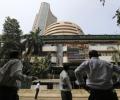
Trading sentiment in the equity markets this week will be guided by global cues, Covid-19 trends and quarterly earnings by market heavyweight TCS, analysts said. Investors will also monitor movement of rupee and crude oil as well as progress of monsoon, they added.

India's recent move to remove additional 'retaliatory' duty on eight products from the United States (US), including apples and walnuts, would not have any negative impact on the domestic producers, the government clarified, even as the issue threatened to snowball into a political slugfest between the ruling and Opposition parties. The move would, in fact, result in competition in the premium market segment, ensuring better quality at better prices for consumers, especially for apples, a senior government official said. "There were certain concerns that were being raised on the mutually agreed solution that has come in, more specific to seven-eight agriculture products where we had levied additional import duties in retaliation to the steel and aluminum measures (imposed by the US)," Peeyush Kumar, additional secretary in the commerce department, told reporters in a briefing.

India's e-commerce market is poised to grow by 84 per cent to $111 billion by 2024 on the back of accelerated adoption of digital technologies amid the COVID-19 pandemic, a report by fintech firm FIS said on Wednesday. The report noted that countries, including India, have seen a shift in consumer behaviour caused by COVID-19, and new payment trends are shown to be on the rise. FIS, in its 2021 Global Payments Report, examined current and future payment trends across 41 countries. India's e-commerce market is projected to grow by 84 per cent between now and 2024 to about $111 billion (from about $60 billion in 2020) driven by mobile shopping, which is projected to grow 21 per cent annually over the next four years, the report said.

Following a more than 15 per cent surge in the National Stock Exchange (NSE) Nifty 50 from this year's lows, the spread between the 10-year government security (G-sec) and the Nifty earnings has approached the danger zone of 2 percentage points (ppt). At present, the G-sec yield is roughly 7.09 per cent, while the Nifty earnings are 5.12 per cent. As a result, the spread works out to 1.98 ppt, ever so slightly below the danger mark of 2 ppt.

While the market may remain volatile this year, analysts expect equities to deliver positive returns by outperforming inflation and government bonds, supported by the fiscal stimulus in the US.

Other than Snapdeal, the four markets are Tank Road in Delhi, Heera Panna in Mumbai, Kidderpore in Kolkata and Millennium Centre in Aizawl. Snapdeal, one of India's largest e-commerce platforms, is known as a place to purchase counterfeit watches and shoes.

rediffGURU Ramalingam Kalirajan answers your personal finance queries.

In August, the Reserve Bank of India Governor Shaktikanta Das held a meeting with chief executive officers/ managing directors (CEOs/ MDs) of large non-banking financial corporations (NBFCs). The discussions included diversifying borrowing sources for NBFCs and housing finance companies (HFCs) to contain increasing reliance on bank borrowing, risks associated with high credit growth in retail segment in unsecured loans, prioritising IT upgrades and cyber-security, improving provisioning, monitoring of stressed exposures and slippages, ensuring robust liquidity and asset-liability management, ensuring transparency in pricing, creating robust grievance redress mechanisms.

High-level intelligence collection will no longer be the preserve of government agencies alone, says Pranjal Sharma.

'There is no need to do anything, let your SIPs get deducted every month, and stick to your allocation between equity, fixed income and emergency funds and your risk covers.'

The number of mergers and acquisitions (M&As) in August that involved private equity (PE) funds was the lowest in nearly three years. There were 26 such deals last month, according to data from tracker Refinitiv (part of London Stock Exchange Group). The last time monthly deal numbers were so low in recent times was January 2021 when Covid cases were picking up during the second wave of the pandemic.

Here's how beginners can follow a very practical approach for finding stocks for long term investing and building a decent portfolio.

People are availing far more of certain kinds of unsecured loans than was the case before the pandemic. Bank lending for buying consumer durables and funding of credit cards and other personal loans have risen by Rs 6.9 trillion between August 2019 and August 2023, shows a Business Standard analysis of data from the Reserve Bank of India (RBI). These loans are typically unsecured, which means they are provided without collateral.

The WHO on Tuesday issued a product alert over contaminated syrup by an Indian manufacturer, warning that it is unsafe for use, especially in children, and may result in serious injury or death.

Target prices around Rs 400 suggest a significant upside.

The Supreme Court adjourned to Tuesday the hearing on a plea of the Securities and Exchange Board of India (SEBI) seeking extension of six months to complete a probe into allegations of stock price manipulation by the Adani group. The hearing on the market regulator's plea and PILs could not take place on Monday due to paucity of time and on account of scheduled hearing of certain matters before a special bench at 3 pm. A bench comprising Chief Justice D Y Chandrachud and justices P S Narasimha and J B Pardiwala on May 12 had said it would consider granting three more months to Sebi for concluding its probe into the allegations of stock price manipulation and lapses in regulatory disclosure.

India is among the top three emerging markets in the wellness economy.

'MNCs now recognise India's capacity for innovation and its pivotal role in substantive contributions to global product development.'

Foreign portfolio investors (FPIs) are likely to get a reprieve from the Securities and Exchange Board of India (Sebi) in case of a passive or unintended breach of the thresholds that trigger additional disclosure norms. According to sources, FPIs whose single group exposure exceeds 50 per cent of their corpus will get 10 trading days to bring down their exposure below the prescribed level, without triggering the stricter disclosure norms. If total equity exposure of an overseas fund exceeds Rs 25,000 crore and it doesn't wish to provide additional disclosures, it will have three months to pare its exposure.

India's corporate sector is likely to report a slowdown in revenue growth and earnings for the July-September 2023 period (Q2FY24), according to earnings estimates by brokerages, after the country's top listed companies posted higher than expected profits for the first quarter. The combined net profit of Nifty50 companies, based on brokerage estimates, is expected to have grown by 19.6 per cent year-on-year (Y-o-Y) to Rs 1.75 trillion in Q2FY24 - a sharp deceleration from 37.6 per cent Y-o-Y growth in the combined earnings of index companies in the April-June 2023 period. According to estimates, the combined earnings in the second quarter would be down 8.8 per cent on a quarter-on-quarter (Q-o-Q) basis and the lowest in the past three quarters.

To make possible discretionary spending including capex and that on welfare, the government decided to borrow more than planned in FY21 -- Rs 12.7 trillion.
CLSA says any correction in the market due to poll related uncertainty could be a buying opportunity.

rediffGURU and financial planning expert Colonel Sanjeev Govila (retd) answers your personal finance-related questions.

Indian drug firms like Marksans Pharma, Aurobindo Pharma, Zydus and Jubilant are recalling products in the US market, as per the latest enforcement report by the US Food and Drug Administration (USFDA). While Marksans Pharma is recalling diabetes drug, Zydus Pharmaceuticals (USA) is recalling drug which is used to reduce stomach acid. Similarly, Aurobindo Pharma (USA) is recalling pain relieving drug, while Jubilant Cadista is recalling a medication used to treat schizophrenia.

"We continue to call on China to be transparent in sharing data and to conduct the necessary investigations and share the results. Understanding how the pandemic began remains both a moral and scientific imperative," Ghebreyesus said.

The state with the most people has displaced the state with the largest economy in terms of investor additions. Uttar Pradesh (UP) added 126,000 new investors in April, reveals National Stock Exchange (NSE) disclosures. This is higher than Maharashtra's 118,000. Maharashtra, which is home to India's financial capital of Mumbai, has traditionally been the biggest source of investors.

Whether it was the MGNREGS or the NFSA or the Aadhaar-based DBT scheme for cash transfer, the Modi government has built on the basic architecture created by the Singh government. Policy makers in the Modi government, instead of discarding them as products of the previous political regime, worked on them, expanded their scope and reach, and used new tools to improve their performance, explains A K Bhattacharya.
 © 2026 Rediff.com - Advertise with us - Disclaimer - Privacy Policy - Sitemap - Feedback - About us - Terms of use - Grievances